Showing posts with label whole grain. Show all posts

Tuesday, April 8, 2014

Whole Grained Meatloaf & Challenge Update

It's taken me a minute to post again because our family computer has been occupied with taxes. I'm sneaking in a post before they're done to tell you that I did it! I ate my 8-grain cereal 3 days last week and already started my week of right be eating it for breakfast this morning. I discovered that making the cereal with milk makes it plenty sweet and filling for me. I used to always make oatmeal with water and then had to add protein powder to sweeten it and bulk up the protein. I like my new plan to go the more natural route and cut down on the steps to make it. I added 1/2 banana and topped it with a plop of cottage cheese or almond butter, depending on the day. I also discovered microwaving it in a giant Pyrex bowl prevents the boil over and microwave mess. 3 minutes did the trick for me.

I also discovered a quick whole grain option at Costco. This little pack microwaves in 90 seconds and fed our little family of 3 - Arjun, me and Monica. Tarala housed her own packet and while she didn't finish it, I did refill her plate 5 times. It was very moist and flavorful. I also like getting the Minute Rice brown or wild rice cups for Tarala. I never mind cleaning up her leftovers. It's one cup of rice and is ready in one minute. I don't really understand how the microwave rice can be so yummy but it's nice to have some time-saving foods to help fit in the whole grains.

Did you know grain could be a verb? Well I just made it one. "Grained" means you make the food a whole grain. I almost always make my meatloaf in these mini tins. I bought mine a while back at World Market before Internet shopping was the gold standard. Now you can get six of these little guys on Amazon for $6.99. They not only make your meatloaf (or banana bread) super cute, but it cuts the cooking time in half. A 30 min meatloaf sounds way more doable on a weeknight than a 60 min meatloaf. Plus it helps with portion control. If you don't want to invest in these muffin tins, you can always bake the meatloaf in muffin tins.

Whole Grained Meatloaf

1 package lean ground turkey (1.25 lbs)
1/2 cup Bob's Red Mill 8-Grain cereal or similar variety
1 egg or 2 egg whites
Few splashes of Worcestershire sauce
2 Tbsp chopped fresh rosemary
Salt & pepper
Squeeze of Dijon mustard

  1. Preheat oven to 450 degrees 
  2. Mix all ingredients in a bowl
  3. Spray tins with non-stick cooking spray 
  4. Bake for 20-25 minutes or until loaves reach an internal temperature of 165 degrees
  5. Serve with a whole grain side or sweet potatoes and a green veggie. Try the microwavable bags of veggies for a quick meal. 

Monday, March 31, 2014

I Dare You to Eat More Whole Grains

As athletes our nutritional needs are higher. We need overall more calories than the sedentary person, so we need more carbs, protein, fluid, and vitamins. Sometimes we lose sight of this and slip into the old adage that because our metabolic ovens burn hot, we can eat whatever we want and more of it. In reality, we should be hyper-focused on what goes into our bodies to efficiently fuel our sport.  In a two part-series, I’m going to challenge you to take a closer look at your food. First, we’ll aim to eat more whole grain sources of carbohydrates. Next week I’ll help you trim out added sugars. So without further ado….


  • Lower the risk of chronic disease
  • Prevents leaky gut and food intolerances
  • Provides us with more antioxidants, fiber, and vitamins
  • Protects cognitive function
  • Reduce inflammation
  • Control weight


Benefits of whole grains to your performance:


  • Longer lasting energy. Whole grains have more fiber and take longer to break down (aka complex carbs). Therefore, they provide you with more sustainable energy.
  • More vitamins. Whole grains are less processed than their “white” counterparts. The refining process strips grains of their endosperm (aka fiber) and vitamins. These vitamins (vitamin E, magnesium, zinc, B vitamins, selenium, phosphorus) help keep our immune systems fighting and help convert our food into energy.
  • More protein. Although not our best source (and not a complete source) of protein, grains do provide us with some. As athletes our needs are higher for recovery and repair, so the added bonus is great. We also know the protein/carb combo helps us recover and keeps us full. One cup of cooked quinoa provides 8g protein versus 4 grams from a cup of white rice. 

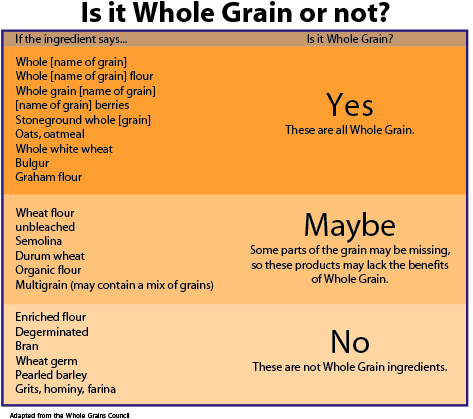
isitwholegrainchart.jpg


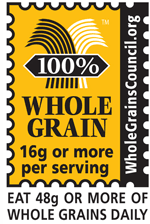
The bread and cereal aisles are even confusing to me, so I thought I’d give you a few tips. First off, you need to pick up the food, turn it over, and look at it before placing it in the grocery cart. Look for the first ingredient to be 100% or look for the whole grain stamp on the box.
whole_grain_logo.gif
Here is a review and list of best bets for bread. Some of the options may have been updated (the list is from a few years back), it will still be a great starting place.


Here is a similar review and list for cereal. I’ve also posted on the cereal aisle before, so make sure to check out that.

An even better bet is to skip the bag or the box and go for the real thing. Instead of bread at lunch, go for brown rice or quinoa (and if you’re really feeling edgy, millet or buckwheat) with some lean meat and veggies. Or have a hot or cold version of the hot cereals at breakfast. If you soak grains overnight in milk, yogurt or other non-dairy beverage, you can eat them cold. I’ve mentioned before that my daughter is really into the Bob’s Red Mill 8 Grain Wheat-less cereal. I don’t like a lot of variety at breakfast and find myself reaching for the cereal bag (I buy those giant, compostable bags of Nature’s Path GF cereals) or some buckwheat frozen waffles so I too need a good nutritional kick in the butt. I am writing it for everyone to witness and hold me accountable: my goal this week is to eat the 8 Grain cereal three times. And I’m going to try overnight oats at least once. Who’s with me? Come on - I dare you! And if you’re already doing oatmeal, explore other hot cereals or mix it up with a combo.


If you are gluten free, it can be more challenging to find whole grains but it’s definitely possible if you put your mind to it. By incorporating grains like amaranth, quinoa (my favorite, as you know!), millet, buckwheat, teff, stone ground corn (polenta, grits), sorghum, and oats*, you can incorporate some hearty starches and not miss out on fiber or vitamins. *Oats are inherently gluten free but are usually processed or farmed with wheat. Gluten free oats are available; Bob’s Red Mill, my favorite whole grain and gluten free product line, offers a variety. You can also substitute some wholesome flours by using a bean or nut flour. We made falafel last night and used garbanzo bean flour instead of AP flour. I had a GF pizza in NY City that was made out of garbanzo bean flour. I think about that pizza all the time and wish I could remember where I got it. I would drive up there this weekend if I could figure it out….Before I diverge any more, you can check out more on whole grain and gluten free by visiting the Whole Grains Council web page. 

Check back later this week to see how my cereal challenge is going. If my 19-month old can do it, so can I!


Sources:

Nutrition Action Healthletter by the Center for Science in the Public Interest
Whole Grains Council

Wednesday, December 30, 2009

The Cereal Aisle...duh duh dunnnn!

In the grocery stores in Canada, Monday is singles night. Guys and gals on the prowl peruse the aisles searching for groceries and the love of their life. Shoppers place a cereal box that describes their personality in the front of the cart. After reading this in the newspaper, I proceded to categorize friends and family as cereal. I became Raisin Bran for my seriousness and hard work (the bran) as well as my silly and spontaneous side (the raisins). One of my friends can be described as Rice Krispies for his constant whining but undeniable fun streak.

The cereal aisle can be overwhelming whether you are looking for a spouse or just breakfast. Stacks of brightly colored boxes grab your attention from every angle. Whatever it is that makes our final decision before placing the box in our grocery cart, it is time to make that an informed decision. There are many aspects to consider when picking your cereal; besides taste, it is important to look at the ingredients and the nutrition label. Try to avoid being convinced of health claims such as, "Can help lower cholesterol," "lose 10 pounds by replacing one meal a day with a bowl of cereal," or "made with whole grains." Health claims in general can be misleading and manufacturers are mostly just trying to sell their cereal.

Instead, turn the box around and focus on mainly two things: fiber and sugar. Cereal should have less than 8 grams of sugar per serving (which vary considerably from brand to brand and type to type) and should not be listed as one of the first three ingredients. Ingredients are listed in descending order by weight. Sugar may be disguised as corn syrup, honey, high fructose corn syrup, fruit juice, dextrose, fructose, or other words ending in -ose. Sugar can be found listed under total carbohydrates, which are also of importance if you are counting carbs (for weight loss or blood sugar control).

Also listed under total carbohydrates is fiber. Now I have often been teased for my interest in fiber (I admit it is listed as a hobby of mine on Facebook) but I can not emphasize the importance of fiber enough when it comes to cereal. Cereal can be an excellent source of fiber and since we need 25 to 30 grams of fiber per day (depending on overall calorie needs), breakfast is a great time to start gettin' it in. Also, if a cereal is high in fiber, it is most likely made from whole grains. Whole grains to look for might include whole oats, barley, rye, buckwheat, amaranth, corn, and anything followed by the word "bran." Fiber will (1) keep blood sugars regular by slowing the digestion of carbohydrates to sugar down, (2) keep "everything else" regular by creating bulk from indigestible material, and (3) keep us full longer by the above mechanisms. Search for a cereal with at least 5 grams fiber per serving.

To give you some direction, the Center for Science in the Public Interest has rated a plethora of cereals based on their nutritional value as well as taste. If you have never read their reviews, written bi-monthly in the Nutrition Action Healthletter, you are surely missing out. Although a bit outdated (April 2006) considering their are new cereals offered all the time, this should give you a good start, get you oriented to the cereal aisle, and help you meet NAN. In summary, their top picks include:
  • General Mills Fiber One Honey Clusters (a uber-fibered version of Honey Bunches of Oats)
  • Kashi Good Friends (Kashi in general does pretty well when it comes to whole grains but double check ingredients, such as in Go Lean varieties, for soy protein isolates).
  • Post Spoon Size Shredded Wheat 'n Bran
  • Weetabix Organic Crispy Flakes & Fiber
  • Kellogg's All Bran, Bran Buds and Original
  • Post 100% Bran (Try adding your own sweetness with Truvia, an herbal sweetener without calories and chemical drawbacks).
Post your favorite cereals as comments. I am personally eating a lot of oatmeal and gluten free Mesa Sunrise these days. I add flax seed and some nuts for a little added fiber and frozen fruit for extra vitamins. Don't forget to add a source of protein when sitting down for breakfast!

Wednesday, December 23, 2009

What to Eat


Driving home from Baltimore to Chicago, I had many hours to kill, or catch up on reading, depending on how you look at it. I dove in to my borrowed copy of What to Eat, written by professor of nutrition at NYU. As a food and nutrition professional, Marion Nestle helps us decifer food culture. She does her best to peel away the layers of politics and marketing mayhem to walk the average consumer through the aisles of the grocery store understanding the nutritional difference between butter and margarine, the biochemistry of high-fructose corn syrup, and the secrets of selling processed foods by adding health claims to the boxes.

Key concepts to walk away with:
  • Organic ¹ healthy - candy is candy whether the sugar is organic or not. Eat organic meat and dairy to avoid extra hormones and antibiotics. Choose organic produce for conventional fruits and vegetables that require high loads of pesticides.

  • Most cereal sends our body into a hyper insulin mania. Added vitamins and minerals do not compensate for the sugar rush, which will inherently cause weight gain. When glucose is not stored as glycogen (because the muscles and liver are already concentrated), the excess sugar is stored as fat. Choose cereals high in fiber, made with whole grains such as oats, bran, buckwheat, barley and amaranth, avoid sugar words in the ingredients especially if it is listed high in the list (a.k.a. honey, high fructose corn syrup, beet sugar, cane sugar, brown sugar, corn syrup solids, sucrose, fructose, dextrose).

  • We get 9% of our calories from bread, so choose wisely. The least amount of ingredients the better - bread does not need to be a science experiment. Go with a multi-grain high in fiber and with no added sugars or hydrogenated oils. Brands I recommend include Baker's, Vermont, French Meadow (especially their spelt or whole rye and yeast free varieties), Pepperidge Farm (some varieties), and Whole Foods and Trader Joe's whole grain varieties.

  • Margarine is made by making a liquid fat more solid by adding hydrogens to the fatty acid chain. This changes the shape of the fat from cis to trans, which basically means bending the fat and causing it to be more plastic. Think of a fat that can bend around the curves of your arteries; not too bad. Then we add hydrogens to that fat so that it will not go rancid, but in doing so, the fat can no longer slip around those curves. Instead we have clogged arteries, inflammation, and poor immunity when eating baked goods, crackers, and peanut butter made with partially hydrogenated oils. Read the ingredients; the FDA does not require food manufacturers to include trans fats in the food label if there is less than 0.5 grams per serving. Be weary of the serving size!
  • Limit soy products, especially highly processed soy. Research is not conclusive regarding the safety of soy. The studies showing the benefits - lowering cholesterol - are backed by manufacturers and other entities that benefit from soy sales. Other research demonstrates that the isoflavones in soy mimic estrogen (phytoestrogens) and may increase risks of prostate, breast, and uterine cancer in genetically sensitive individuals. Note: this may be a problem for men and women alike. If you do like soy, stick to tofu, edamame, miso, tempeh, or soy milk with limited processing. Avoid soy protein concentrates and soy protein isolates. To make these food ingredients, found in cereal, protein bars, powders, and veggie burgers, the soybean must be heated to such extreme temperatures that any benefits are destroyed. In general, high temps create problems; the same is true when heating fats or oils to high temperatures, such as in frying.

Trying to be a more conscientious grocery shopper? This book is for you. And because it is written by a noteworthy nutrition professional who did extensive research, it is a trusted source. You will also find that it is written with conversational tone with some science added in, but not too much that you need a chemistry degree to decipher (although I do have a chem degree so please post if this is not a true statement).